Showing posts with label Plot board. Show all posts

Monday, 5 December 2016

Plot board 2: the layout

-->
Okay, a little bit more about the plot board! I use it to pin ideas on in the planning stages, to help with restructuring and editing in the revision stages, and just generally to help me to think through my book in a visual way when I need it.

Before I blog about how I’m using it on my current book, I might as well explain how I lay it out, otherwise none of it is going to make sense!

If I could have one very, very long board so I could see the whole of my story in one line, I would, but since they don’t make cork boards that shape, I have to make do with splitting the story up into four sections: Act 1,Act 2: split into two parts – a & b,Act 3.

I don’t think there are any set rules when it comes to story structure. Some story gurus split the story into three acts, others split it into four. There are different terms to for different parts of a story, depending on who you read or who you listen to, but most tend to outline the same basics elements of a story; they just have different ways of describing it. My advice is to go with what works makes sense to you; I’m just going to share what fits my personal process the best.

As I mentioned in my last post, I like the way Michael Hauge splits up a story: three acts, with a turning point between each, and then turning points in the middle of each act. Now, this can sound a bit artificial – and some of you reading this may be breaking out in hives at the thought of all this scary structure! – but even before I knew any of this, my stories tended to hit these breaks and turning points. I think it’s because stories that work tend to have a certain rhythm, certain rises and falls in tension, twists and turns in direction to keep them interesting. Quite often I don't plan what's going to be a turning point, but it becomes obvious as the story evolves.


If you look at my empty plot board pic, you can see I have some headings in yellow and these are my stages/turning points. I’ll outline them here and then over the next few posts I’m going to go into more detail:

Act 1
Section 1: Ordinary world
Turning point 1: The call to adventure
Section 2: Debate & denial
Turning point 2: Change of plans

Act 2
Section 3: Progress (Fun & Games)
Turning point 3: Point of no return
Section 4: Complications & Higher Stakes (Bad guys close in)
Turning point 4: Black moment

Act 3:
Section 5: Final push (Dark night of the soul/Solution)
Turning point 5: Climax
Section 6: New world (Aftermath)

Next time, we'll break down Act One...

Tuesday, 29 November 2016

The Plot Board

I posted a picture of one the most vital tools in my writing life on Twitter yesterday and was surprised by how much interest it got. I'm talking about my plot board. This is it, bare and ready for a new story:

Nothing too special. Just a A1-sized cork board with added bits of string, pins and headings on cut-up index cards. However, I've found I'd struggle to write a book without it!

I can’t claim to have invented the idea – far from it – but I’ve been tweaking my own approach for about ten years now. I don't always use the board the same way twice - it really depends on the story, but I'm fascinated about plotting and story structure and I wondered if blogging about my process as I write the next book might a) be useful to someone else who loves this kind of stuff and b) actually help me work out exactly why this helps me so much!

I think part of it is that I’m quite a visual thinker and it helps me to ‘see’ the structure of my book this way.  It also provides a place to put all those ‘lightning bolt’ ideas I get about my book before, during and after the first draft.  You  know the kind of ideas I mean: the ones you get when you’re minding your own business, not even really thinking about the book and – BAM! – suddenly you know why your heroine is acting that way, or the perfect setting for a scene comes to mind, or just a line of dialogue pops into your head and triggers something off.

When I get those kind of ideas – and they are generally my best ones – I scribble them down and pin them to my board. My board follows a chronological timeline of my work-in-progress, and when I think about where to pin that scrap of paper it often becomes instantly obvious where and when it should go. Do things move and change as I work on the book? Absolutely. That’s why God gave us coloured pins! That’s the beauty of a plot board: nothing is set in stone.

My first plot board looked a little different. My whole approach to plotting was much less sophisticated (and probably much less neurosis-inducing) back then. I’d read that a good way to plot was to think of 20 things that needed to happen in your book. That’s what the pink index cards are: 20 plot points for the story. Then, as other ideas came to me, or notions of how I could develop those plot points floated to the surface of my consciousness, I tacked them onto the board next to the relevant plot point.

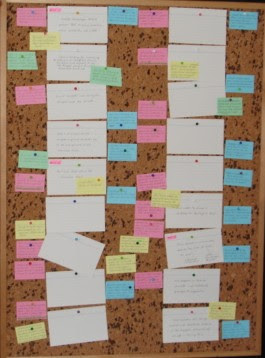
I then switched to trying to divide the board into acts. I particularly liked Michael Hauge's way of breaking down a story, I tried dividing my board into six stages with five turning points, on the right, but found I couldn't quite fit everything on there so it was easy to see the flow of the story. Then I read Save The Cat by Blake Snyder.  Great book, and I loved his idea of storyboarding too.  He divided his story board into four horizontal strips: Act 1, Act 2a, Act 2b and Act 3.  I immediately decided to try the same thing, and discovered I now had room to use my plot point cards in chronological order, but I still had room to pin all the little flashes of ideas around them too.  So this is what the plot board of my recently finished book, The Other Us, looks like:


So that's the introduction to my plot board, next time... the different stages of a story and where they go on the plot board.

Monday, 7 November 2011

Should've stayed on board...

Just got revisions back for Always The Best Man (whether it keeps that title or not remains to be seen!).  It seems that my ending feels a little rushed.  I had suspected as much myself, and when I got my trusty plotboard out, I could see why!

This is the current incarnation of my plotboard. 
There are four rows:
  • act 1
  • first part of act 2
  • second part of act 2
  • act 3


Compared to the beginning of the story, the last act is a little sparse!  And if I'd paid attention to my board instead of ignoring that while I wrote the final chapter or two, I might have worked that out for myself.

I find having visual map of my book exremely helpful in both the writing and revising stages.  In the first draft I can scribble my ideas on post-its and index cards (or bits of envelopes etc.) and often there is an obvious place to pin those ideas when I look at my board.  In the revising stage, I can start to jiggle cards around and see what's working and what isn't.

Anyway, can't stay round here blogging all evening.  I've got a book to revise!  Back to the board for me...


Wednesday, 31 October 2007

Is there room for a little magic?

Mel asked:

"I guess my question is what surprises you when you actually start to write the story? What you planned isn't always what happens. So surprises?"

I still totally surprise myself when I'm writing. For me, my plot board is a bit like a journey plan, a route map. I know my starting point. I know my destination (Happy Ever After!). And I know some of the major landmarks (events) and changes of direction along the way (turning points).

You can plan a route in great detail, but it's not until you actually drive that road that you really know what it feels like to be there - what the scenery is like, what little details you will find that you can never discover until you are there in person.


A couple of years ago, my family and I drove from Inverness in Scotland, to the Isle of Skye. We knew we had to go down the side of Loch Ness, take a right at such-and-such a town and keep going along the yellow line on the map until we got to the bridge that took us onto Skye. Part of the route looked something like this (click here to see map). Not very exciting, is it? I'd stick the picture in, but the map is copyrighted, so only the link.

What I discovered along the way were sights like these:


And I also experienced wind that was so cold it felt like knives on my skin, that made the inside of my ears burn when I got back into the warm. We saw deer running over the hillside and watched the winter sun turn dull patches of hillside the most wonderful golds and browns and mossy greens.

Thankfully, writing is about the journey, not about getting to the destination in the shortest amount of time. If it were, every romance book would be only three sentences long, starting with: "Boy meets girl..."

So, when I get into my character's skins and take a journey with them, unexpected things happen. Where I thought I would have a long, straight uncomplicated run, I suddenly find a road block and have to take a detour. Sometimes I discover that the road I thought was the right way is actually taking me in the wrong direction and I have to scrap the map and start again. Other times, the road is just dull, but I glimpse a much a much prettier/dramatic/dangerous route nearby. Some landmarks are worth lingering over, and some are just a blur as I pass them by to visit somewhere that I thought looked dull, but have just realised has become vitally important.

Quite often, the surprises are in the details. The little things that add richness and texture to the book. In "Her Parenthood Assignment", I had no idea Gaby was going to give herself a makeover after she found a video of Luke's dead wife. I knew she was going to feel threatened by the dead wife's memory and I had a little card on my plot board that said: "Gaby finds a home movie of Luke's wife?". That was one of those little detours that suddenly became essential.

Another example of a surprise is in "Break Up to Make Up". I knew Adele and Nick were going to take a journey together in a car that Adele had bought since their split. And I knew that Nick was going to have a fit that she'd sold his beloved jeep, but I didn't know that Adele was going to enjoy being the naughty one, just for once. I giggled with Adele as she waited for Nick to realise...

In my next book "English Lord, Ordinary Lady", I didn't know Josie's wig was going to fall in the soup... And that's all I'm going to say about that! You'll just have to buy it in February to find out more.

Really, my board is just a way of getting all the myriad ideas about the book out of my head (where they are whizzing at great speed and liable to get lost) and tuen them into something visual. I'm a very visual person, so I need to be able to picture things to remember them most of the time. Tell me your name, I'll forget it. But if I see it on a name badge, I'll keep that little memory snapshot with me for much longer.

Sunday, 28 October 2007

It's that time again

Well, since I'm at the start of a new book - and procrastinating wildly - I've hauled my plot board out from behind my desk again. As always, I've had different Idea of how I'm going to lay it out this time. But I'm not sure the actual look of the thing makes a blind bit of difference as I've decided that it's not how the finished article that is important, but the process I go through, ordering my thoughts about the story and getting the key plot points and themes in my head.

Since I've been reading "Story" by Robert McKee and listening to sessions from this year's RWA conference by script-consultant Michael Hauge, I've decided to do something a little more sophisticated (and flexible) than my normal method of pinning on 20 cards with the major plot points of the story. This book, my plot board is all about story structure.


I've clocked up a fair number of "How to.." books on writing in the last few years and, while they all have different terms for the necessary building blocks for a story, there are certain key elements that pop up again and again and I thought I would blog about these as I finish honing the shape of Louise and Ben's story.

I've decided to use Michael Hauge's method of six phases of the story, with 5 turning points (TPs) as transistions from one to the next. Not as many things to remember as Vogler's Hero's Journey and a little more detail than the classic three-act structure.

The whole thing divides up as follows:

  • Set-up (ending with TP1 - Opportunity)
  • New Situation (ending with TP2 - Change of Plans)
  • Progress (ending with TP3 - Point of No Return)
  • Complications and Higher Stakes (ending with TP4 - Major Set-back)
  • Final push (ending with TP5 - Climax)
  • Aftermath


Thursday, 24 May 2007

More about the journey

I've been thinking about my plot board in the last few days and wondering why I feel the obsessive need to mess around with cards and pins and a cork board. I do have a stationary fixation –I always had to have my felt tips in rainbow-coloured order at school – but it's more than that.

At the beginning of a book, when the ideas are flying round and I have no idea of which ones are going to work and which ones are going to get axed, I find it very handy to pin these "flying" thoughts down before they flutter off into the atmosphere, never to be seen again.

However, once I have passed the halfway point in the book, I hardly ever look at my plot board again. Maybe by then the choices have been narrowed down and that helps me keep the picture of where the book is going in my head. I also think that maybe my plot boarding is more to do but the process than the finished result.

Somehow, the journey of pinning those little cards on the board and organising my thoughts galvanises me to write and helps me make sense of the scraps of ideas that come to me in the middle of the night, while I'm walking to work and especially in the bath. Where do you get your best ideas?

Sunday, 20 May 2007

Plot Board revisited

Okay, I know I said I was going to block a bit more on the Hero's Journey, but before I get into that I'm going to go off on a tangent and talk about my plot board. I'd kind of half-decided not to use it with the current book, but then I read India Grey's blog post (see "Glamour Hangover" ) mentioning it and I thought I would give it another go.


Basically, I'm the sort of person that thinks in pictures. I'm much better at retaining information if I can see it, for example, written down, or if I can visualise it somehow in my head. If I receive complex information only by listening, I often miss or forget some of it. Perhaps this is why I am absolutely awful at remembering names and much better at remembering faces.

Anyway, when I was first starting to try and write a novel, someone somewhere suggested writing the numbers 1 to 20 down on a page and putting the main plots points from your story on the list. I found that approach useful in helping me guage at which point in the story some of my ideas should go, but every time I changed my mind about what was going to happen I had to scribble it all out and start a new list. So I decided to make use of a spare corkboard and some index cards I had tucked away in my house.

Every time I do a plot board, I take a different approach, trying out new things. Here are my original posts (post 1 & post 2) about it. Since then I've tried reducing the plots cards to one central row by snipping the cards in half. It was great to see the flow of the story from the top of the board to the bottom, but I found I didn't have enough room at the edge of each plot card to put all my little "idea" scraps of card. So, this time I've come back to the original format with two rows of full-size index cards containing the main points of my plot. I’ve also messed around with the colour scheme – inspired by the fact I was starting to run out of large pink cards!

White cards – on these I write the central plot points. For my latest book, the first one reads "Fern's friend challenges her to say yes to every question she is asked for a week". This leads to Fern being roped into doing a charity bungee jump because she can't say no, so the next cards reads (not surprisingly) "Fern is tricked into doing a bungee jump”. As you may be able to see if you look closely at the photogrpah, at the moment I know what's happening in the first act and the third act but the middle bit of my story is scarily blank. Whoops.

Pink & blue cards – one of the most important things I use my plot board for is for mapping out the hero and heroine's character arcs and working out what they are feeling/struggling with at each point in the plot. I used to do this all on the same coloured cards, but this time I decided to use pink for the heroine's and blue for the hero's.

Yellow cards – these are my little flashes of inspiration. It could be a point about the character or a possible idea for the plot, the little details that come to me every now and then that help flesh out the story. I tend to use these more for an idea to do with a fixed point in the story, for example: "Josh suggests doing something dangerous and Fern is proved right".

Green cards – these I've used for theme and general points that have relevance throughout the whole story, for example: "Fern finds it hard to live in the moment; Josh finds it hard to do anything but."

I'll probably change it all around next time I do it, but I'm glad I persevered with it for this book. It helped me get a clear idea of the story in my mind as I started to write and I find that scribbling down little ideas and character details and pinning them on my board often sparks my imagination and I come up with even more ideas.